AI Business Models Beyond Efficiency: What Must We Own?
Most discussions about AI business models begin with what AI can automate. The harder question is what a business must still own when execution becomes cheaper and more widely available. AI is making companies more capable while making many of their existing business models less valuable. Work that once required teams of people can now be completed faster, at a lower cost, and with fewer people. Yet many businesses still earn through hours billed, people deployed or expertise applied.
The contradiction is uncomfortable: the more effectively they use AI, the more they may erode the basis of their present revenue. Customers will still need outcomes. But they may need much less of our execution to achieve them.
When customers depend less on what we do, what must they depend on us for?
The ownership question
The immediate response is to build AI products, platforms and services. But models, tools and infrastructure are becoming increasingly accessible. Technology ownership alone may not provide an enduring advantage.
I can already sense this transition in my own work. I use AI increasingly for market research and reporting. It helps me examine more information and prepare work faster, while my direct familiarity with some of those activities begins to recede.
Yet when I try to create a large AI-led strategic opportunity, more intelligence does not automatically reveal the new value. AI can analyze the customer, map the market and generate possibilities. It does not decide what we should own, what partners should bring, or why an ecosystem must come together.
The strategic question is therefore not only what AI can do. It is how intelligence, capabilities and participants can be arranged to create an outcome that did not exist before. That is the role of the value architecture: the design that connects customer context, intelligence, ecosystem participants, measurable outcomes and the way value is shared.
Why AI efficiency is not a business model
AI can automate existing activities, improve margins and protect the present business. But making the current model more efficient is not the same as creating the next one.
The greater risk is how we look: at the customer through familiar categories, at the product through its present function, and at AI through productivity and cost reduction.
AI expands what we can know, but much of that knowledge is based on what has already been recognized and recorded. If the categories remain unchanged, more intelligence may only reinforce the world we already understand.
The next business model may therefore begin by encountering what is actually happening before the present model defines the opportunity for us.
Where AI business model innovation begins
Consider any product: a camera, appliance, vehicle, medical device, industrial machine or piece of enterprise technology.
Its conventional value chain is linear. It is designed, manufactured, sold, serviced and eventually replaced. The manufacturer understands the design; the supplier, the component; the retailer, the transaction; the service provider, the failure; and the customer, the experience. Each participant sees a different part.
If we ask where AI can be inserted, we will find many useful applications: forecasting demand, detecting defects, predicting failures and automating support. These improve the existing value chain.
But what if we ask a different question? What becomes visible when the product is encountered not only as an object but also as part of the customer’s activity, interruption, aspiration and relationships? A camera does more than capture images. An appliance does more than perform a household function. Every product sits inside a wider field of use involving customers, manufacturers, suppliers and service partners. When those partial views come together, the product becomes more than just something to sell and maintain. It becomes a point through which an ecosystem can create value.
The opportunity may not be inside the product. It may be inside the relationships around it that no participant can see alone.
How an AI workflow transforms value
Imagine that a product in use produces an unusual signal.
The difference becomes visible when we compare the existing service workflow with a redesigned value workflow.
Before: the service workflow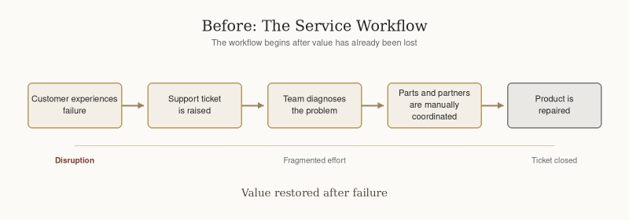
Figure 1. Reactive service workflow: value is restored only after failure.
The workflow begins after value has already been lost. The customer experiences disruption, participants perform separate tasks and the provider is paid for the effort required to restore the product. The ticket is closed, but much of the learning remains inside the case.
After: the value workflow
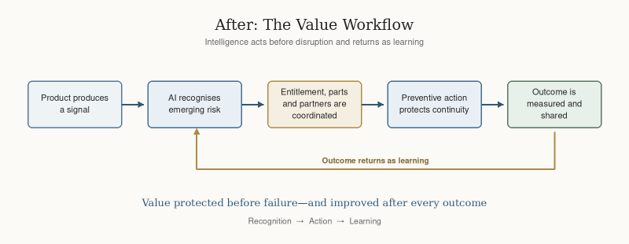
Figure 2. AI-enabled value workflow: signals become preventive action and learning.
AI connects the signal with operating history, environmental conditions, service records and component behavior. An emerging risk is recognized before failure occurs. The value architecture then coordinates entitlement, parts, service partners and customer communication. The intervention protects continuity rather than merely restoring the product. The outcome returns as learning. It can improve future diagnosis, supplier components, manufacturing controls, product design and warranty performance.
AI has not simply been inserted into the old workflow. The workflow has been reorganized around a different outcome: protecting what the customer depends upon.
What changes beyond predictive AI?
| Before GenAI: predictive AI | After GenAI: contextual and agentic AI | New value | |
| Understanding | Detects patterns in structured data | Interprets product signals, customer language and service knowledge together | Context-aware recognition |
| Action | People coordinate fixed workflows. | Agents coordinate permitted actions and escalate exceptions. | Faster, adaptive intervention |
| Learning | Knowledge remains across separate cases and teams. | Outcomes improve the product and ecosystem. | Fewer repeat failures |
| Customer proposition | Predict and repair product failure. | Protect the activity enabled by the product. | Guaranteed availability |
| Business model | Payment for service activity | Recurring and outcome-linked payment | Participation in value created |
Predictive AI detects emerging failure. GenAI interprets information that previously remained fragmented. Agentic AI can coordinate the permitted response. These capabilities create a new business only when the customer proposition changes. The customer may not primarily need maintenance. The customer needs the activity enabled by the product to remain uninterrupted. The manufacturer can then move from selling maintenance to guaranteeing availability. The provider is paid for continuity rather than effort deployed or incidents handled. Suppliers and service partners participate in the same outcome.
Predictive AI detects. GenAI interprets. Agentic AI coordinates. Value architecture creates the business.
The transformation is clear: from repairing a product to protecting an outcome to building a recurring business around it.
Owning the value architecture
A product delivers a function. A platform connects participants. A value architecture determines the outcome they will create together, how intelligence becomes action, and how the resulting value is shared.
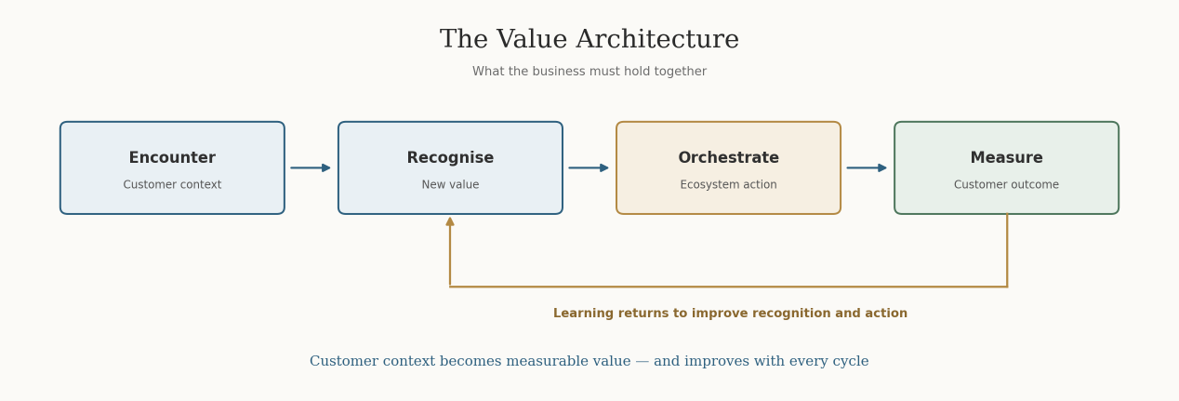 Figure 3. Value architecture: customer context becomes measurable value and returns as learning.
The architecture clarifies what we must own and where partners make the system stronger.
| Value layer | What we must own | What partners bring | Value created |
| Customer context | The relationship and quality of encounter | Data, access and domain knowledge | Previously unseen needs |
| Intelligence to action | Decision logic, permissions and governance | AI models, cloud and specialist tools | Faster, trusted decisions |
| Ecosystem orchestration | Workflow, roles and incentives | Operations, supply, service and capital | Coordinated preventive action |
| Outcome economics | Outcome measures and commercial design | Execution capacity and performance data | Recurring and outcome-linked revenue |
| Learning loop | Accumulated context and feedback | Product and process improvements | Compounding advantage |
This approach differs from building a platform and inviting partners to join it. A platform begins with an asset. A value architecture begins with an outcome that no participant can create alone.
Participants remain because the architecture makes each of them more capable. The customer gains continuity; the manufacturer, product intelligence and recurring revenue; the supplier, earlier visibility; and the service partner, better diagnosis. Its defensibility comes from connected workflows, trusted relationships, verified outcomes and learning that compounds with every cycle.
This is valuable interdependence.
From AI efficiency to a new business model
Once value architecture becomes the unit of ownership, the economics change.
| Business stage | New customer value | Revenue model |
| AI efficiency | Faster, lower-cost execution | Effort or capability fee |
| Ecosystem prevention | Fewer failures and disruptions | Recurring service |
| Outcome protection | Guaranteed continuity or performance | Outcome-linked participation |
If AI only reduces the effort required to diagnose a service case, the provider earns from efficiency. If the ecosystem prevents failure, the provider can earn for improved performance. When the customer begins purchasing guaranteed availability, a new recurring business has emerged.
The decisive transition is from being paid for an input to participating in the value of an outcome.
People do not disappear from this model; their value moves. AI can recognize patterns, interpret context and coordinate permitted actions. People must still encounter the customer, recognize possibilities beyond the existing requirement, design the relationships and remain responsible for the consequences.
AI strengthens the value architecture. Human responsibility gives it direction.
What companies must own in the age of AI
The temptation is to begin with capability: What can the model do? Where can an agent be deployed? Which process can be automated? These questions can produce useful solutions. But they can also keep us inside what we already understand.
The more important questions are:
- What is happening that no participant can see alone?
- What new outcome could be protected or created?
- What must connect for that outcome to arise repeatedly?
Only then should we decide what to automate, what to own, where to partner and how to monetize.
As intelligence becomes abundant, advantage may not come from owning more technology. It may come from owning the architecture through which customer context, intelligence and ecosystem capabilities become measurable value.
Industrial-age advantage came from owning production. The digital age shifted that advantage towards platforms and customer interfaces. Now, in the age of AI, the more enduring advantage may belong to those who own the value architecture.
Do not own every component. Own the architecture that makes them valuable together.