AI Decision Making in Leadership & The Loss of Inner Authority
Understanding the true impact of AI decision making in leadership requires looking at a subtle transformation. It alters how choices are formed. Fundamentally, it changes who forms them.
In a pricing meeting, an automated model recommends a 7.3% increase. The data is clear, the logic is sound, and the answer already exists. Everyone turns to the leader. There is a brief pause, and then: “Let’s go with it.”
It looks like a decision. However, the system has already shaped the outcome long before that moment. This example highlights a massive, silent shift in executive management. Instead of forming the choice, the leader simply routed it.
Meanwhile, something else begins to fade quietly. It is the ability to stand inside a decision and say, “This is mine.” This is not a failure of individual capability. Instead, it represents a much quieter shift: the erosion of inner authority.
The Hidden Pressures in AI Decision Making in Leadership
Today, choices rarely begin in a neutral space. They arrive carrying heavy external pressure, such as growth expectations, margin constraints, competitive speed, and the visible push toward automation. Consequently, the decision carries a clear direction before discussion even starts.
In such an environment, clarity is no longer just useful. It becomes a sanctuary. Systems that reduce uncertainty compress complexity, accelerate action, and make outcomes easier to defend.
Because of this shift, Defensibility quietly replaces Conviction. A decision is no longer judged only by whether it works. It is judged by how easily it can be explained. It must survive scrutiny, align with data, and carry reasoning others can follow.
While this dynamic grants organizations stability, it shifts something vital at the same time. When the logic already exists, the choice feels less like something leaders must form. It feels more like something they can simply accept. Responsibility remains, but the center of gravity has moved.
In many boardrooms, this hesitation is subtle. The numbers are strong, the recommendation is clear, and the direction carries institutional confidence. Yet before final commitment, there is often another pause.
This second stop happens because true ownership is absent, not because information is missing. Another review is requested; another scenario is explored. Validation enters the room once again. Underneath the continued discussion, a deeper search is occurring: the decision-maker is looking for enough external support to reduce the psychological weight of standing behind the choice alone.
How Algorithmic Defensibility Reshapes AI Decision Making in Leadership
Under pressure, this movement deepens further. Decisions are no longer only about direction. They involve exposure—the risk of being wrong, challenged, or left standing alone.
In these moments, structured recommendations feel safer. They are harder to question because they carry the weight of data, not necessarily because they are more accurate. As a result, preference slowly shifts away from what leaders deeply see—Mushin (無心), or clear seeing—and toward what they can defend most easily.
The tension becomes glaring when growth, profitability, and automation pull in different directions. Efficiency can improve and margins can rise through patterns. However, growth often requires movement beyond what is already known. It requires timing, positioning, and commitment long before full validation appears.
At that point, the alignment breaks down. External optimization begins to erode inner authority.
Rarely does this hesitation appear as overt fear. More often, it shows itself through over-confirmation, extended alignment loops, and the growing need for defensible consensus before any decisive movement. Systems operate through patterns to stabilize the known and make outcomes predictable. Leadership, however, must operate beyond those boundaries.
Some choices require deliberate deviation. This means entering before clarity, committing before certainty, and acting without complete support. These decisions cannot be fully derived. They do not scale. They require raw judgment.
Reclaiming the Decision-Maker: The Human Premium
This deeper shift alters what happens to the decision-maker. Legacy leadership has always depended on a deeper capability—the capacity to stay steady in uncertainty, observe clearly, and decide without needing complete validation. This is Inner Authority. It does not appear in dashboards or reports, yet it exists inside every decision that carries real weight.
Over time, it begins to erode. It does not happen suddenly or visibly.
Repetition causes the erosion. Each time leaders accept a decision without fully “seeing” it, the erosion deepens. Each time machine clarity replaces human engagement, the loss grows. Nothing feels wrong in the moment; in fact, the process feels much easier.
Still, the nature of the act changes. The decision no longer forms from within; it arrives from the outside. Gradually, the ability to stand without support weakens—not because it disappears, but because leaders exercise it less. Inner authority does not fade through failure. It fades through disuse.
The Shift from Deciding to Confirming
Eventually, the mechanics of management transform entirely. When someone has already suggested the direction, established the reasoning, and shaped the answer, what remains is mere agreement. This validation process is efficient and often effective, but a fundamental truth shifts underneath:
Leaders are no longer forming the decision. They are accepting it. Over time, repeated acceptance turns deciding into confirming.
On the surface, everything looks like progress. We see better tools, richer data, and sharper clarity. However, these metrics do not improve together:
-
Clarity increases, but ownership does not.
-
Speed increases, but depth does not.
-
Confidence increases, yet conviction does not always follow.
The more choices rely on external support, the less leaders develop internal clarity. This is not a structural breakdown. It is an identity shift. Clarity is scaling, but inner authority is not. This imbalance is becoming one of the defining tensions of modern corporate governance, forcing a re-evaluation of how we integrate automated workflows.
What leaders are losing is not intelligence, access to information, or capability. They are gradually losing their ability to remain the exact point at which a choice is truly made. Ironically, that specific capacity is becoming the only true competitive advantage.
In an environment where intelligence is abundant, answers appear instantly, and direction is constantly suggested, having more data no longer gives you an advantage. The advantage now comes from refusing to let it overrule you.
-
It demands seeing clearly even when everything already carries an automated interpretation.
-
It requires deciding independently even when everything already carries a system suggestion.
-
It takes acting with absolute ownership even when everything already carries structured support.
This is the Human Premium. It is not an asset added but a quality retained. It is not a new skill but a refusal to lose what was always central.
When intelligence becomes external, the role of the human does not disappear—it sharpens. What remains is this: the ability to stand by a decision not already made for you.
Balancing Automation and Human Intent
The question is not whether organizations should use modern systems. They must. However, the more important question is much quieter: Where does the decision actually happen?
-
Does it form within and receive external support?
-
Or does it form externally and receive internal acceptance?
That single distinction will define the relevance and effectiveness of AI decision making in leadership going forward. Nothing here suggests stepping away from automated systems. They are necessary, and they will continue becoming exponentially more capable. However, something essential must remain: the ability to stay present in the act of deciding.
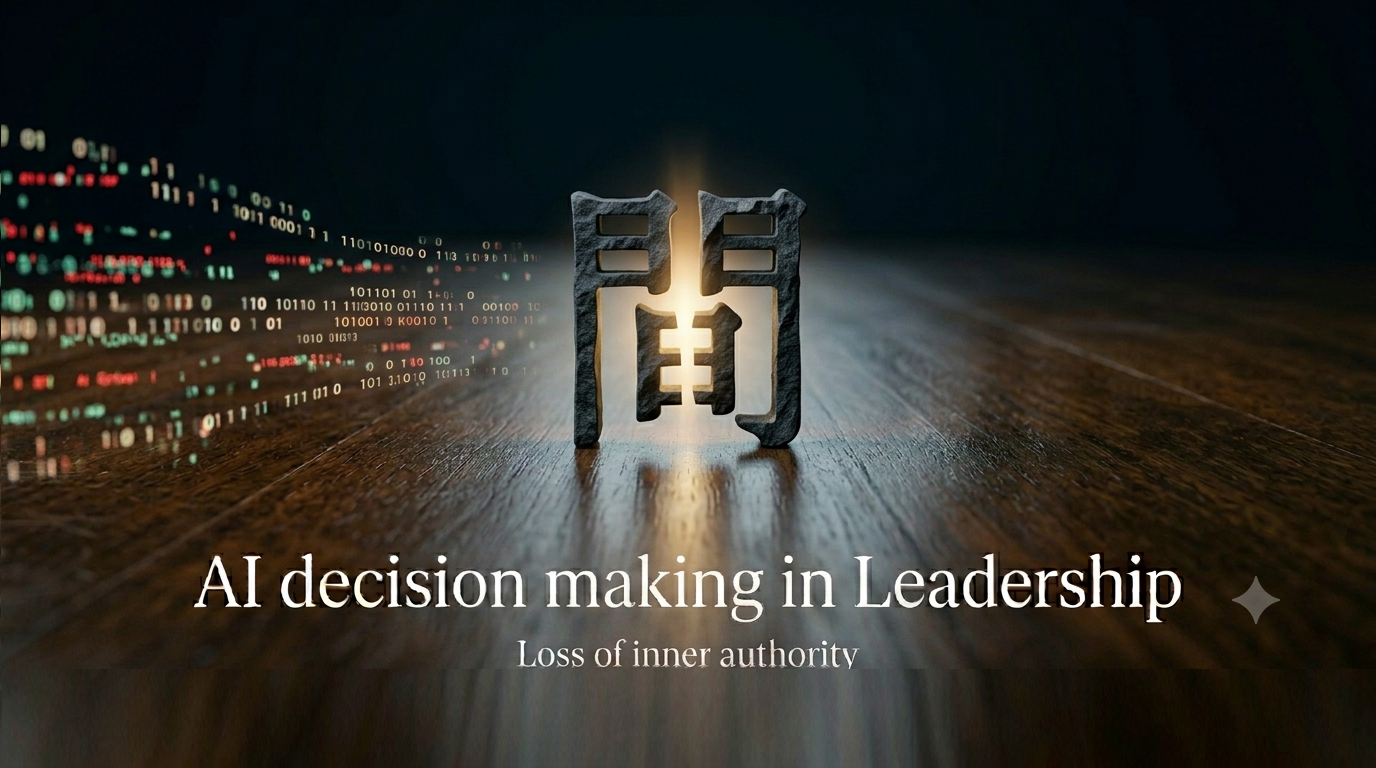
Leaders must transition from legacy data “processors” into structural systems designers. To stop the erosion of judgment, you must notice when agreement replaces seeing and recognize when validation replaces formation. Reclaiming this space does not require a complex new framework. Instead, it requires a deliberate application of Ma (間)—the intentional pause:
-
It requires a readiness to pause when speed receives the highest reward.
-
It demands asking sharp questions when clarity appears deceptively complete.
-
It takes the courage to stand alone even when a structured safety net is available.
The risk is not that systems take over. The deeper risk is quieter: that over time, it becomes easier to rely and harder to see. It becomes simpler to accept and seemingly less necessary to decide.
Ultimately, true maturity in handling AI decision making in leadership means recognizing exactly how inner authority fades. It fades through repeated non-use, not through catastrophic loss. When intelligence becomes external, judgment must become intentional.
You may be interested in my blog: https://www.isacnewton.com/the-unlearning-alpha-why-strategic-subtraction-is-the-next-frontier/