The Unlearning Alpha: Why Strategic Subtraction is the Next Frontier
1. The Spectrum of Adaptation and the Unlearning Alpha
A profound shift is currently underway in our executive circles. Consequently, we are witnessing a divergence in how we meet the horizon of 2026. If you are struggling with the unlearning alpha process, rest assured that you are not failing. Instead, you are simply reaching the structural limit of your legacy operating system.
Some among us have already pivoted. In fact, they are treating the surge in machine intelligence as a high-velocity partner to amplify their vision. But this article is written for the rest of us—for those who feel the mounting friction. I feel it, too. It is the exhausting weight of applying decades of hard-won, manual expertise to an environment that no longer rewards the “grind.” The path forward requires the courage to unlearn. Furthermore, we are transitioning from an era where “doing” was the primary currency to an era where “deciding” is the only value that remains.
2. The Unlearning Alpha: Moving from Cognitive Labor to Strategic Intent
For most of our careers, we equated our value with cognitive endurance. We built our professional identities as the ultimate “processors.” Specifically, we prided ourselves on being the first to see the raw data, the first to draft the deck, and the first to respond to the crisis.
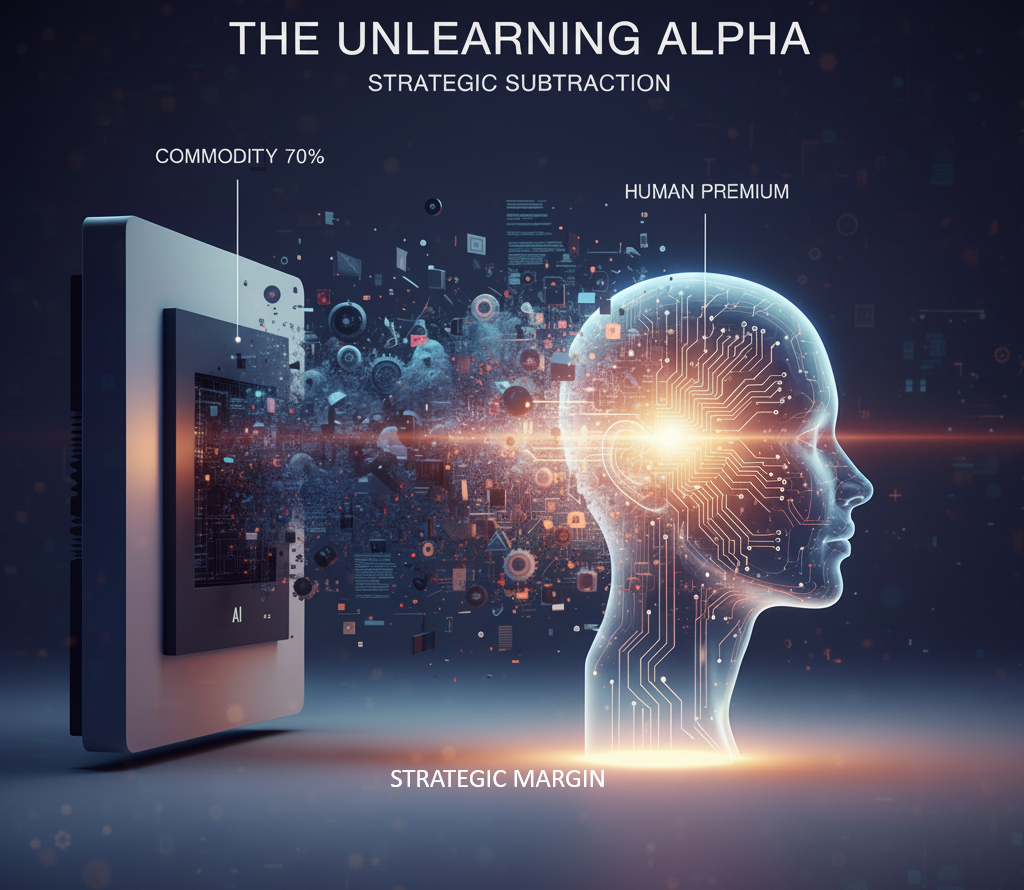
However, as the cost of processing information trends toward zero, sheer cognitive effort is no longer a competitive advantage. When we spend our mental voltage on tasks that can now be handled instantly by AI, we aren’t being diligent. Conversely, we are leaking the energy required for high-level judgment. The leaders finding their stride today—those who embody the unlearning alpha—have reclaimed their mental space for the Human Premium. This premium is the rare, non-automatable ability to synthesize nuance and manage the emotional fabric of an organization. It is the one thing that machines cannot replicate: intent. Intent is the spark that gives data direction. It is the ability to look at a sea of AI-generated insights and decide, “This is the path we must take, and this is the reason why.”
3. The Fusion: Automation + Intuition
The “Fusion” isn’t about replacing ourselves. Instead, it is about reallocating our cognitive capital. Think of it as a two-tiered system that separates commodity labor from architectural design.
-
The Automation Layer (The Commodity): Machines handle the heavy lifting of data aggregation, pattern recognition, and initial drafting. This is the “first 70%” that used to consume our workdays.
-
The Intuition Layer (The Alpha): This is where we operate. Because the machine handles the noise, we are free to apply our high-context, historical judgment to the final 30%.
This fusion works effectively because it allows the machine to provide the breadth of information, while we provide the depth of decision-making. We aren’t doing less work; rather, we are doing higher-leverage work. The goal is to move from being a “doer” who executes tasks to an “architect” who designs systems. An architect does not lay every brick; instead, they ensure the structure can withstand the pressures of the landscape. For further reading on how machine intelligence is reshaping the workforce, see this report from the World Economic Forum. By adopting the unlearning alpha, you stop competing with the machine and start orchestrating it.
4. The Art of Strategic Subtraction (The Zen of Less)
While the competition is racing for distraction—adding more layers of complexity and performative busyness—the Alpha leader finds power in the Void. Strategic Subtraction is an act of purification. Ultimately, it is the art of realizing that in a cluttered world, the most powerful move is often to remove, not to add.
-
The Meeting Audit: Most meetings are ghosts of a pre-AI era. If you are an observer, you are a bottleneck. Consequently, you should delegate the input and restrict your participation to the decision point only. By removing yourself from low-value syncs, you gain the “strategic margin” needed for high-level thought.
-
The Legacy Purge: Identify one recurring report you monitor out of habit. If a machine can synthesize the insight, the raw data is noise. Purge it. When you stop looking at the noise, your clarity increases exponentially.
-
The Constraint of One: For the next week, resolve one high-complexity problem using only human intuition and one AI-assisted model. Remove all “committee alignment” steps to see if the outcome improves with speed. Often, committee alignment is merely a tax on your courage.
5. The Immovable Mind and the 3-Question Audit
Our organizations look to us as the “Grid.” A “Mirror Mind”—a core tenet of Zen—is the ability to reflect the fire of disruption without being consumed by it.
Like a mirror, the mind reflects the chaos of market shifts or the noise of competition without becoming “attached” to those images. It remains clear, steady, and ready to reflect reality exactly as it is. This is not passive; instead, it is the ultimate form of active, unburdened leadership. To bridge the gap between philosophy and action, I use these filters:
-
The Autophagy Test: If I were starting my role today, with no prior history, would I still perform this specific task? If the answer is “no,” you are maintaining a legacy, not building a future.
-
The 70/30 Rule: Am I spending my time on the “Commodity 70%” or the “Architectural 30%” where my unique judgment is the only thing that matters?
-
The Velocity Check: Is this process protecting an old habit, or is it accelerating our current mission?
The Path to Architectural Leadership
We are entering a phase where the “Expert Manager” is fading, but the “Systems Architect” is wide open. To be an unlearning alpha, you must accept that your value is no longer in what you can do yourself. Instead, your value is found in the systems you design.
When you start to subtract, you will face resistance. Your team may equate “busyness” with “value.” As a leader, your job is to redefine that metric. You must transition your team from rewarding “effort” to rewarding “outcomes.” This journey of unlearning alpha isn’t something we do because we’ve failed; it’s something we do because we are ready to level up. If you want to dive deeper into building these systems, check out my previous guide on Strategic Velocity. Ultimately, the invitation is to empty the cup—to let go of the legacy habits that no longer serve us—and to lead from a place of clear, unburdened vision. The first step is to decide what we are finally ready to let go of.
You may be interested in my blog: https://www.isacnewton.com/human-in-the-age-of-ai/